Every miner has a line. Below it, the bitcoin it produces no longer pays for the electricity it burns. That line is its shutdown price, and it comes down to two numbers: the machine’s efficiency in joules per terahash (J/TH) and what you pay for power.
The tables below work it out for the common combinations. Find where your machines sit, then decide whether to keep running, tune down, move, or retire them.
How the shutdown price is calculated
Shutdown price = J/TH × 24 ÷ 1,000 × power price ($/kWh) ÷ BTC earned per TH per day
A 30 J/TH machine uses 0.72 kWh per terahash per day. At $0.07/kWh that is $0.0504 of power per terahash per day. Since the 19 September 2026 difficulty adjustment, a terahash has earned about 0.00000048 BTC a day (0.00048 BTC per PH/s), so bitcoin has to be at $105,000 just to cover the power.
Shutdown price table
Bitcoin price, in US dollars, at which power cost equals mining revenue. Rows are machine efficiency; columns are electricity price per kWh. Assumes 0.00048 BTC per PH/s per day.
| J/TH | $0.02 | $0.025 | $0.03 | $0.035 | $0.04 | $0.045 | $0.05 | $0.055 | $0.06 | $0.065 | $0.07 |
|---|---|---|---|---|---|---|---|---|---|---|---|
| 30 | $30,000 | $37,500 | $45,000 | $52,500 | $60,000 | $67,500 | $75,000 | $82,500 | $90,000 | $97,500 | $105,000 |
| 25 | $25,000 | $31,250 | $37,500 | $43,750 | $50,000 | $56,250 | $62,500 | $68,750 | $75,000 | $81,250 | $87,500 |
| 20 | $20,000 | $25,000 | $30,000 | $35,000 | $40,000 | $45,000 | $50,000 | $55,000 | $60,000 | $65,000 | $70,000 |
| 18 | $18,000 | $22,500 | $27,000 | $31,500 | $36,000 | $40,500 | $45,000 | $49,500 | $54,000 | $58,500 | $63,000 |
| 16 | $16,000 | $20,000 | $24,000 | $28,000 | $32,000 | $36,000 | $40,000 | $44,000 | $48,000 | $52,000 | $56,000 |
| 14 | $14,000 | $17,500 | $21,000 | $24,500 | $28,000 | $31,500 | $35,000 | $38,500 | $42,000 | $45,500 | $49,000 |
| 12 | $12,000 | $15,000 | $18,000 | $21,000 | $24,000 | $27,000 | $30,000 | $33,000 | $36,000 | $39,000 | $42,000 |
| 10 | $10,000 | $12,500 | $15,000 | $17,500 | $20,000 | $22,500 | $25,000 | $27,500 | $30,000 | $32,500 | $35,000 |
| 9 | $9,000 | $11,250 | $13,500 | $15,750 | $18,000 | $20,250 | $22,500 | $24,750 | $27,000 | $29,250 | $31,500 |
Where common machines sit
Using manufacturer-rated efficiency. Real figures move with firmware, tuning and ambient temperature.
| Model | J/TH | $0.03 | $0.04 | $0.05 | $0.06 |
|---|---|---|---|---|---|
| Antminer S19 95T | about 34 | $51,000 | $68,000 | $85,000 | $102,000 |
| Antminer S19 XP | 21.5 | $32,250 | $43,000 | $53,750 | $64,500 |
| Antminer S21 | 17.5 | $26,250 | $35,000 | $43,750 | $52,500 |
| Antminer S21 XP | 13.5 | $20,250 | $27,000 | $33,750 | $40,500 |
| Antminer S23 | 11 | $16,500 | $22,000 | $27,500 | $33,000 |
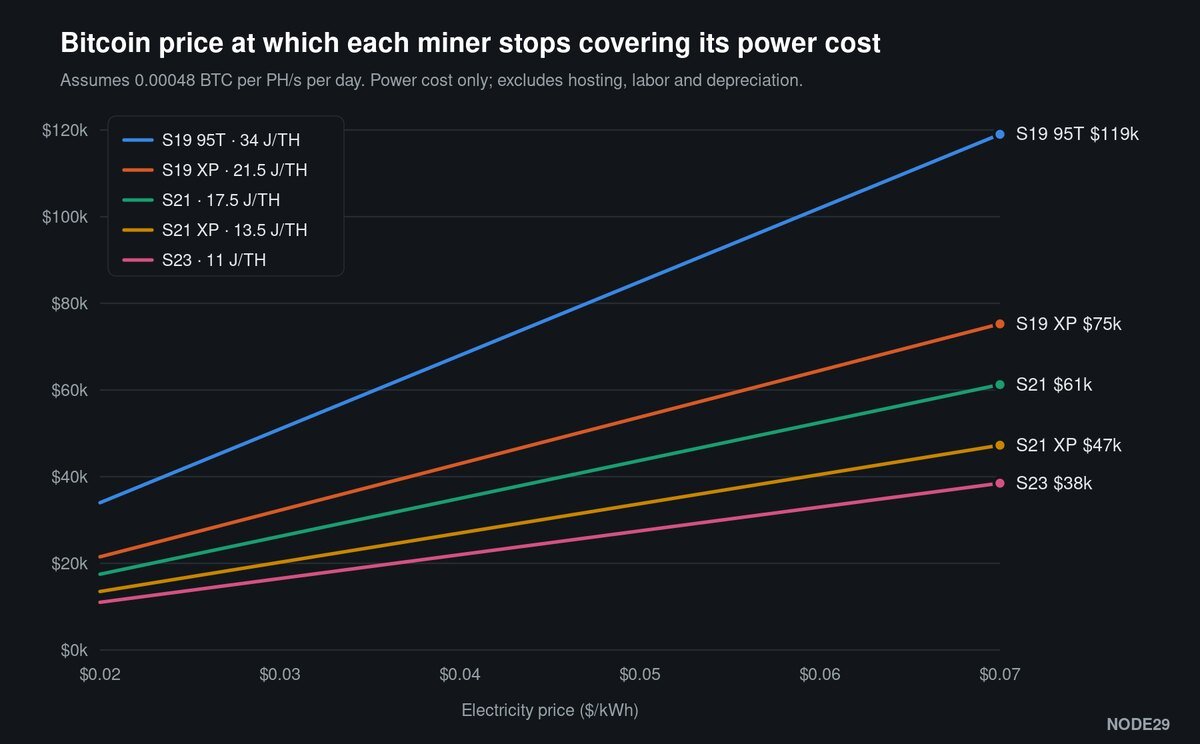
The gap is the point. At $0.05/kWh an S19 95T needs bitcoin at $85,000 to break even on power, while an S21 needs $43,750. The same bitcoin price can leave one fleet profitable and another running at a loss.
The assumption that moves the whole table
BTC earned per terahash is not fixed. It falls when network difficulty rises and recovers when difficulty drops. To adjust the table to the figure on the day:
Your shutdown price = table value × 0.00048 ÷ current BTC per PH/s per day
If difficulty rises about 20% and output drops to 0.00040 BTC per PH/s, multiply the table by 1.2: the 30 J/TH, $0.07 cell moves from $105,000 to $126,000. Your pool dashboard shows what your machines actually earn; Hashrate Index publishes the network figure as BTC hashprice.
What the table leaves out
The shutdown price covers power only. The point where a machine actually stops paying is higher, because of:
- Hosting and pool fees. A hosting contract billed by slot or reserved power may keep charging while the machine is off.
- Labour and site operations.
- Repairs and parts. Overclocked fleets wear through power supplies and fans faster — see Overclocking vs Undervolting.
- Depreciation.
So a fleet within 10–20% of its shutdown price may look profitable on paper while losing money once everything is counted.
Options when you are close to the line
- Undervolt or underclock. Trading some hashrate for efficiency can pull a machine back above the line. Push voltage too low and chips become unstable in ways that look like hardware faults — see Overclocking vs Undervolting.
- Run it somewhere cheaper. An S19 that loses money at $0.05/kWh can still earn at $0.035 — see what to do with old ASIC miners.
- Switch off and wait. If you restart when the price recovers, check for dust, moisture and connector damage first — see What to Check Before Restarting Idle Miners.
- Retire the machines. Part them out as spares or sell the batch. NODE29 buys old and faulty miners, as well as individual hashboards and parts, wherever they are located.
Close to the line?
Whether you need parts, repairs, or a buyer for a batch of older machines, send us the miner model, quantity, condition and location, and we will put together a quote.
Hashprice: Hashrate Index Roundup, 28 September 2026. Efficiency figures are manufacturer ratings.